Craft market stall ideas
Craft stall ideas include jewellery, candles and soaps, textiles, toys, art prints and cards. Each category has its own safety and labelling rules, and many markets only admit goods you made yourself within a set distance. Check the rules for your category, and the market's own criteria, before you buy materials.
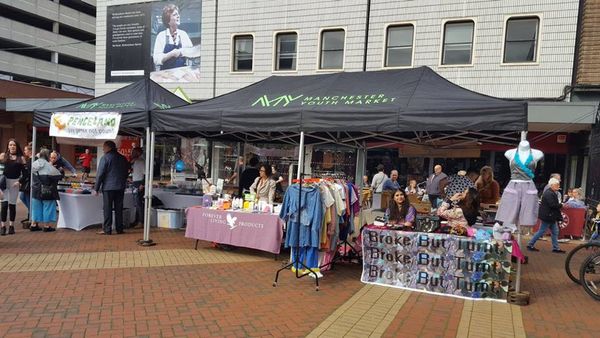
Craft stall ideas grouped by what they need
A craft stall idea is only as good as its fit with the market and the rules for the product. Some categories, such as prints and cards, carry few product-specific rules. Others, such as candles, cosmetics and toys, come with safety regulation, testing and labelling. Markets then add their own filters, including handmade-only rules and distance limits.
This guide groups ideas by category and sets out what each needs, using council product safety pages, a trade insurer's guidance and the criteria of real markets. The sources reviewed give no sales figures or margins for any craft, so none are given. This is general guidance, not legal advice. Contact your local Trading Standards service or an adviser for decisions about your own products.
Jewellery and accessories
Rings, earrings, necklaces, hair accessories and bags are common craft stall lines. Cornwall Council's craft and jewellery makers page says wearable items must keep their metal content within legal limits and points to guidance on nickel, lead and cadmium.
Precious metal changes the rules again. Protectivity's guide to the laws for selling handmade crafts says hallmarking is a legal requirement for items made from gold, silver, platinum or palladium, and that makers register with one of the four UK Assay Offices to receive a maker's mark. Cornwall Council's page does not cover hallmarking, so check the Assay Office position before selling precious metal items.
Candles, soaps and cosmetics
These are popular and carry the heaviest compliance load among common craft lines. Protectivity says candles must comply with the General Product Safety Regulations 2005, with a risk assessment covering fire, toxicity and stability, plus clear safety information. It adds that candles containing hazardous substances can need hazard labelling under the CLP Regulation, and recommends burn tests and records of the results.
North Yorkshire Council's product safety page says all cosmetic products supplied in the UK must comply with the Cosmetic Product (Safety) Regulations 2008. Protectivity makes the same point and says cosmetics must be safe, correctly labelled and not misleading. Soaps, balms and bath products usually fall into this group.
Toys and children's items
Wooden toys, knitted toys and play items attract families, and they bring safety obligations. North Yorkshire Council says handmade wooden toys need no mandatory testing but must be safe, with splinters and rough edges removed, and that wheels on simple wooden vehicles have been found to detach and create a choking risk. Paints and varnishes must suit toys.
Cornwall Council notes that new toys have their own labelling and safety requirements and that rules differ for second-hand toys. Protectivity refers to the Toys (Safety) Regulations 2011 and their essential safety requirements. On marking, GOV.UK's Toys (Safety) Regulations 2011 guidance for Great Britain (last updated 24 March 2025) says CE marking is recognised indefinitely in Great Britain, so a toy assessed by self-declaration can carry UKCA or CE. UKCA is needed where a UK Approved Body did the assessment. It also says the responsibilities apply to people acting in the course of a commercial activity, so a regular market seller is covered. Speak to Trading Standards about your own design.
Textiles, home items, art and paper goods
Cushions, bags, knitwear, tea towels and clothing sit here. Cornwall Council says textiles must be labelled with their fibre content. West Suffolk Council's market business start up guidance includes case studies of traders selling canvas and bespoke printing, wool and knitting accessories, and exotic house plants, which shows the range of niches markets have welcomed. The guidance says it contains no sales data, so treat the examples as ideas to test.
Items made to look like food have special rules, according to Cornwall Council. Check before selling novelty items that look like food. Ask the market office, too, whether it wants a risk assessment for your range, since Knutsford and the Farmyard Market ask for one.
Paintings, prints, greetings cards, calendars and stationery carry fewer product-specific rules, though the general duty to sell safe products applies. Their main hurdles are market criteria. Arundel Town Council's farmers market criteria place paintings, prints, cards, jewellery, woodwork, toys, homeware, clothing, ceramics, leatherwork and candles in a handmade craft category and require items to be made locally, within 40 miles of the market and preferably from local materials.
Market rules that shape which craft you can sell
Markets curate. The Farmyard Market in Truro states in its terms and conditions that it prioritises local, handmade products, that traders must say on the application whether items are bought-in or handmade, that undeclared items may be removed, and that it may limit over-saturation of one product type, so applying does not guarantee a space. Its becoming a trader page lists handmade goods, homegrown produce and culinary creations among what traders may sell.
Arundel limits guest craft traders to three visits a year, who must be UK-made and based within 100 miles, at the organisers' discretion, and allows only products listed on your application. Bath Christmas Market assesses locality, product quality, business ethics, range, retail mix, customer profile and price range, and says its process is not first come, first served.
West Suffolk's guidance says you can trade as a casual trader for up to 12 weeks without a licence on its markets, then apply for a permanent licence. Other councils differ, so ask.
Setting up a craft stall that makes the range easy to read
The Farmyard Market's stall setup advice suggests making it obvious where customers should stand and how to browse, leaving room so nobody feels rushed, and avoiding laying everything flat by using crates, boxes or small shelves for varied heights. It recommends putting the items you most want noticed at eye level and keeping heavier items lower.
On signage, the same page says customers should understand who you are and what you sell at a glance, and that pricing should be simple and easy to read, with tidy handwritten prices acceptable. It suggests grouping similar items by type, size or flavour, separating items customers can handle from those they cannot, and using small battery powered lights, which matter at indoor or dim markets. A short printed note on origin, making process and ingredients can help during busy periods. A related guide on market stall display ideas goes further.
Insurance, tax and paperwork
Protectivity says craft fair organisers and councils often require proof of public liability insurance before you set up. Arundel asks for £5 million public liability and £5 million product liability, with employers liability normally at £10 million if you have staff. West Suffolk recommends public and product liability. Product liability matters for categories such as candles and toys, where the item itself can cause harm.
On tax, GOV.UK's guidance on tax free allowances describes the trading allowance as up to £1,000 a year of gross trading income. If your gross trading income is £1,000 or less you generally do not need to tell HMRC. If it is over £1,000 you can deduct the allowance instead of actual expenses, and the page says you must register for Self Assessment by 5 October following the end of that tax year. Check your own position with HMRC or an adviser.
A selection framework for choosing a craft
| Craft group | Product rules to check | Market filters seen | Insurance angle | Testing or records |
|---|---|---|---|---|
| Jewellery | Metal limits for nickel, lead, cadmium (Cornwall). Hallmarking for gold, silver, platinum, palladium (Protectivity). | Handmade and local criteria (Arundel). | Public liability. Product liability worth asking about. | Assay Office registration for precious metal. |
| Candles, soaps, cosmetics | General Product Safety rules and CLP labelling for candles. Cosmetic regulations for cosmetics (North Yorkshire, Protectivity). | Handmade declaration (Farmyard Market). | Product liability expected by some markets (Arundel). | Burn tests and ingredient records (Protectivity). |
| Toys and children's items | Safe design, suitable paints, toy labelling rules (North Yorkshire, Cornwall). | Local and handmade criteria apply. | Product liability. | Wheels and small parts checks. |
| Textiles and home | Fibre content labelling (Cornwall). | Category curation to avoid over-saturation (Farmyard Market). | Public liability. | Keep supplier details. |
| Art, prints, cards | General safety duty only. | Local makers favoured (Arundel). | Public liability. | Keep original files and print records. |
Choose the group where you already hold the materials, the skills and the paperwork. Prints and cards suit a quick start. Candles and cosmetics reward makers who accept the testing workload.
What to do next
- Pick one craft group and read the matching rules above.
- Contact Trading Standards for your products if you use anything covered by safety or cosmetics rules.
- Check the criteria of two markets for handmade, distance and bought-in rules.
- Ask each organiser for its public liability minimum and whether product liability is required.
- Weigh down your gazebo as the operators ask. Several markets ban stakes, and Gala Tent is one place to look for gazebo set-up information.
- Photograph your range for applications, since Bath and Newcastle ask for product images.
- Book a trial date, and record what sold and what drew questions.
Frequently asked questions
Do I need a licence to sell crafts at a market?
Often the market operator's permission is what you need, with no separate licence. Councils run their own schemes. West Suffolk says you can trade as a casual trader for up to 12 weeks without a licence on its markets. Cornwall Council notes that a pedlar's certificate has its own conditions, including trading on foot. Ask the market office.
Can I sell bought-in goods at a craft market?
Many markets prohibit it. The Farmyard Market in Truro asks traders to declare on the application whether items are bought-in or handmade and may remove undeclared items. Arundel's criteria say producers must make what they sell. Check each market's rules and declare honestly.
What do I need to sell handmade candles?
Protectivity says candles must comply with General Product Safety rules, with a risk assessment and clear safety information, and that candles with hazardous substances can need hazard labelling. It also recommends burn tests with records. Cornwall Council points candle makers to product safety guidance. Confirm requirements with Trading Standards.
Do handmade toys need testing?
North Yorkshire Council says handmade wooden toys need no mandatory testing but must be safe, with rough edges removed and suitable paints. Wheels on simple vehicles have been found to detach, so check them. Cornwall Council says new toys have labelling requirements. GOV.UK says UKCA or CE marking can be used for self-declared toys in Great Britain. Speak to Trading Standards for your design.
What insurance do craft stallholders need?
Protectivity says organisers and councils often require public liability proof. Arundel asks for £5 million public liability and £5 million product liability. West Suffolk recommends public and product liability. Product liability suits items such as candles and toys. Confirm each organiser's level.
Is hallmarking compulsory for jewellery?
Protectivity says hallmarking is a legal requirement for items made from gold, silver, platinum or palladium, with registration through one of the four UK Assay Offices. Cornwall Council's page does not cover hallmarking. Contact an Assay Office before selling precious metal pieces.
Gazebos built for regular pitches
Once a pitch is confirmed, the stall needs to fit it. Gala Tent makes market stall gazebos for traders who set up week after week.
Useful pages on our sister sites
Event Industry Trader is published by Gala Tent. These pages from Gala Tent and the wider Gala group go further on the kit, branding and payments covered here.
Where to check the rules
- Cornwall Council: craft and jewellery makers
- North Yorkshire Council: product safety
- Protectivity: laws for selling handmade crafts in the UK
- West Suffolk Council: market business start up guidance
- Arundel Town Council: farmers market criteria guidance
- The Farmyard Market: terms and conditions
- The Farmyard Market: becoming a trader in Cornwall
- The Farmyard Market: market stall setup
- Bath Christmas Market: stallholder applications
- GOV.UK: tax free allowances on property and trading income
- GOV.UK: Toys (Safety) Regulations 2011, Great Britain
Rules vary by council and by event. Confirm requirements with the organiser and the relevant authority before you act.